How to Optimize Agentic Workflow Cost and Latency
Agentic workflows get expensive when every handoff carries too much context. This refresh shows how tracing, model routing, caching, parallelism, and Agiflow state make workflows cheaper without making them less reliable.
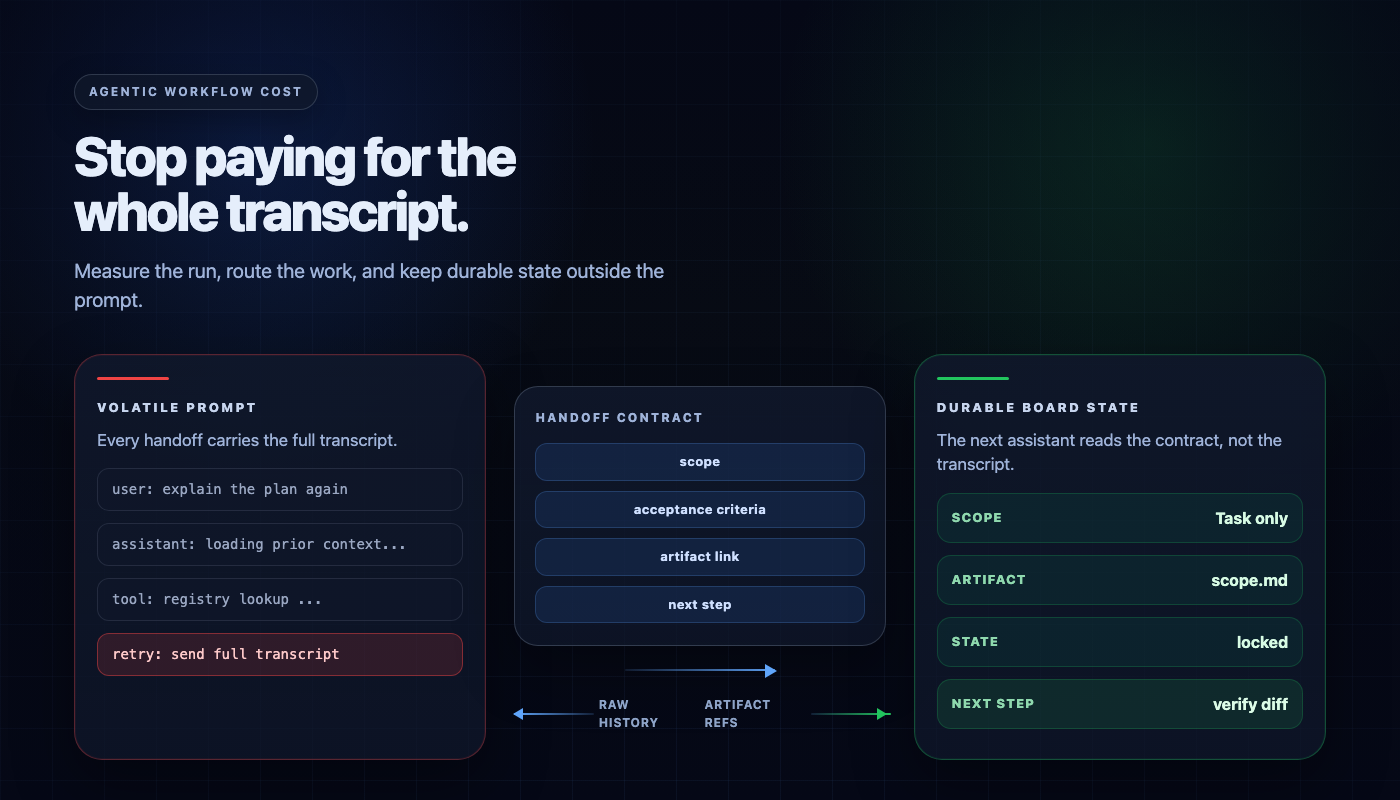
Agentic workflows rarely become expensive because one model call is expensive. They become expensive because the workflow shape quietly multiplies work: every handoff carries history, every tool catalog loads in full, every retry resends context, and every independent lookup waits for the previous one to finish.
The fastest way to optimize agentic workflow cost is to treat the workflow as an architecture problem before treating it as a model selection problem. Measure the run. Remove redundant LLM calls. Shrink the context each step receives. Route work by risk. Parallelize independent tools. Keep the plan, artifacts, acceptance criteria, and status outside the prompt.
That last point is where Agiflow fits. Agiflow is not the agent runtime. The assistant stays the agent. Agiflow is the AI-readable project board and MCP-connected project management surface that gives external assistants scoped board tools, task state, artifacts, prompt skills, vault entries, and workflow locks without forcing the whole plan to live in chat memory.
Short answer
To reduce the cost and latency of an agentic workflow without making it less reliable, trace every model call and tool call first, then remove the work that does not need an LLM. Keep deterministic steps in code or tools, route low-risk language tasks to cheaper models, reserve stronger models for judgment, pass only the state each step needs, and verify risky outputs before the next step runs.
The important part is order. Model routing helps, but only after you can see where tokens, cached tokens, latency, retries, and tool calls are coming from. Vendor and framework guidance points in the same direction: diagnose bottlenecks, make fewer LLM calls, reduce input context, use faster or smaller models where acceptable, and parallelize independent work [10].
| Lever | When it works | What to measure | Reliability guardrail |
|---|---|---|---|
| Observability | Before any optimization | Input, output, cached tokens, latency, retries, tool calls | Keep traces per workflow step |
| Model routing | Steps have different risk levels | Cost and error rate by step | Reserve stronger models for reasoning and review |
| Context discipline | Handoffs carry raw history | Prompt tokens and cache misses | Pass structured outputs and artifact links |
| Prompt caching | System prompts and tool definitions stay stable | Cache reads, cache writes, misses | Do not use caching to excuse oversized context |
| Parallel tools | Calls do not depend on each other | Wall time by tool group | Keep merge and verification gates explicit |
The hidden cost driver is usually not a single dramatic mistake. It is accumulation.
An agent loop starts with a task, then a tool result, then a reflection, then another tool result, then a handoff. If each new step receives the full history, the prompt grows even when the actual decision stays small. Google describes context engineering as a first-class architecture discipline for production multi-agent frameworks and warns that appending raw history and verbose tool payloads creates cost and latency spirals [7].
Long context can also make the workflow less reliable. The "Lost in the Middle" paper found that long-context model performance can degrade when relevant information appears in the middle of the context [14]. That does not mean long context is bad. It means unbounded history is a poor substitute for a clear state contract.
Practitioners describe the pain with simpler language: context spikes, too many tools, every handoff adds seconds, cache misses, and the plan should live outside the prompt. Treat those as symptoms. The fix is not to shame multi-agent design. The fix is to stop letting every step inherit the whole transcript.
| Hidden driver | How it appears in a trace | First fix |
|---|---|---|
| Full transcript handoffs | Input tokens grow every step | Pass structured output plus artifact links |
| Oversized tool catalog | Large prompt before work begins | Load only relevant tools or use tool search |
| Sequential independent tools | Wall time scales with tool count | Batch or parallelize independent calls |
| Repeated system prompts | Same prefix processed repeatedly | Add prompt caching where provider support exists |
| Unclear ownership | Retries and corrections after handoff | Add acceptance criteria and verification gates |
Measure before optimizing agentic workflow cost
An optimization pass without traces is a guessing exercise. At minimum, each workflow step should record:
- Step name and owner
- Model name
- Input tokens, output tokens, and cached tokens where the provider exposes them
- Latency
- Tool call count
- Retry count
- Finish reason or error
- Artifact path or structured output handed to the next step
OpenTelemetry defines GenAI semantic attributes for model requests, responses, token limits, finish reasons, response IDs, and timing [5]. Langfuse tracks token usage and costs for LLM generations and embeddings, including cached tokens and multiple usage types [6]. Those two facts are enough to set the bar: an agent workflow should be traceable at the same granularity as any other production system.
The first trace review is usually humbling. You may find that the "reasoning" step is cheap while the registry lookup loop is slow. You may find that one prompt cache miss wipes out the expected saving. You may find that a retry path doubles spend because it includes the whole tool output from the failed attempt. Good. Now you know what to cut.
Classify each step before assigning an agent
The original dependency-upgrade workflow behind this article had five useful sub-tasks:
- Fetch and parse the current dependency manifest
- Check each dependency against the registry
- Assess whether a version bump is likely to introduce breaking changes
- Generate the updated manifest
- Write a summary pull request description
Only two of those obviously need a strong reasoning model: risk assessment and final synthesis. The first two are data and tool tasks. The fourth is structured generation. OpenAI's pricing documentation shows large cost differences across flagship, mini, nano, cached input, batch, flex, and priority modes [3]. Anthropic also positions Sonnet 5 as a cost-performance option for agentic work and publishes token pricing [4].
The exact model names matter less than the classification habit.
| Step type | Good execution path | Example from dependency upgrades | Risk if misrouted |
|---|---|---|---|
| Deterministic tool or code | Code, script, database query, registry API | Parse package file, fetch available versions | Wastes tokens on work a tool can do |
| Low-risk language transform | Small or cheaper model | Normalize changelog snippets | Minor wording errors, usually easy to catch |
| Judgment and tradeoff | Stronger model | Breaking-change assessment | Wrong upgrade recommendation |
| Human-gated decision | Human approval after agent prepares context | Merge, publish, delete, external request | Irreversible or public mistake |
Flatten handoffs into a pipeline
Multi-agent workflows only pay off when each boundary reduces work. If every handoff adds another explanation, another transcript slice, and another round of clarification, one stronger agent may be simpler and cheaper.
The dependency-upgrade workflow is easier to optimize as a pipeline than as a meeting. One step emits a structured manifest summary. The next step emits version candidates. The risk step emits an upgrade decision with evidence. The final step writes the PR description. Each step stops when its contract is fulfilled.
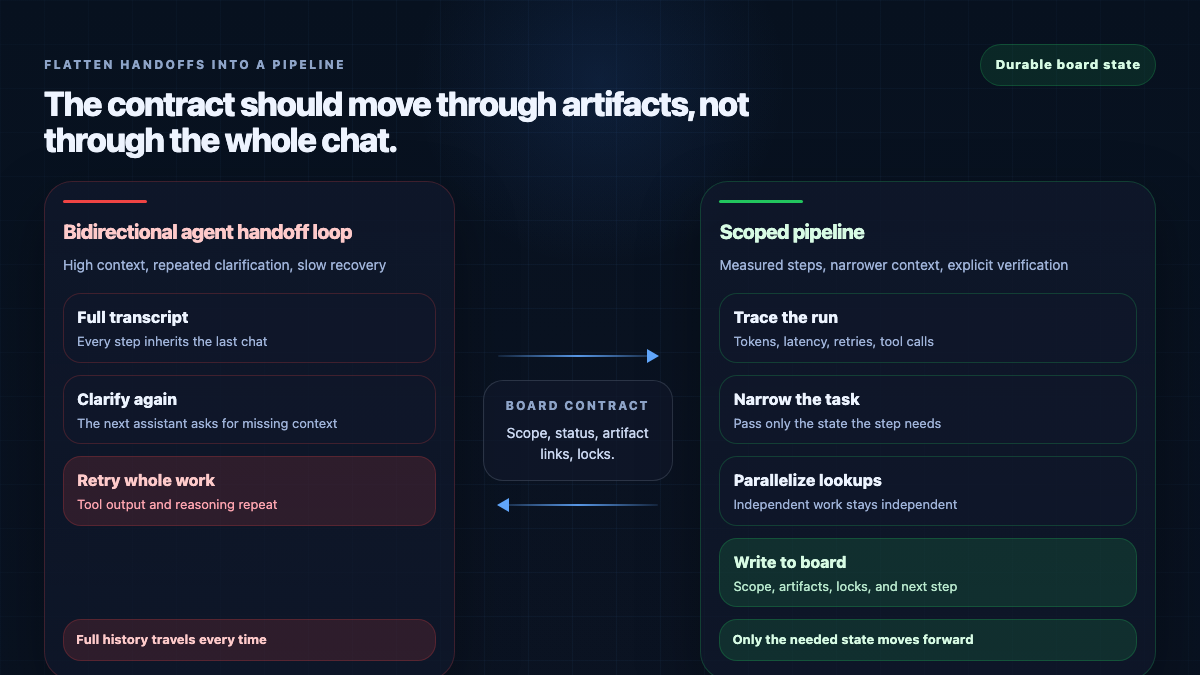
The Agiflow-specific pattern is to move the work contract into durable state. Put the task scope, acceptance criteria, artifact links, current status, and locks in the board. Then a downstream assistant can read the task record or artifact it needs instead of receiving the entire prior conversation. That is the same architectural idea behind multi-agent orchestration and handoff contracts, but applied to cost and latency.
There is a reliability reason too. The MAST paper analyzes more than 1,600 multi-agent traces across seven frameworks and identifies 14 failure modes across system design, inter-agent misalignment, and task verification [13]. Boundaries are not bureaucracy. They are where you catch drift before it spreads.
Use prompt caching for stable prefixes
Prompt caching is a real lever, but it is narrower than people want it to be.
Stable system prompts, policy text, and tool definitions are good cache candidates. Anthropic's prompt caching documentation states that cache reads are priced at 0.1x the base input token price, 5-minute cache writes at 1.25x, and 1-hour cache writes at 2x [1]. OpenAI's prompt caching works automatically on recent models when prompt prefixes match exactly and can reduce latency and input token cost when those prefixes stay stable [2].
That does not mean caching fixes poor workflow shape. Cache misses, output tokens, cache writes, stale sessions, tool bloat, and oversized context can still dominate spend. A cached 20,000-token prefix is better than an uncached one. A 4,000-token scoped prompt may be better still.
The practical rule is simple: make static prefixes cacheable, then keep dynamic context small enough that a miss does not ruin the run.
Parallelize independent work
Parallelism is the latency lever teams often miss because agent frameworks make sequential loops feel natural.
In a dependency-upgrade workflow, checking 40 dependencies against a registry does not require 40 serial reasoning turns. The checks are independent. The agent can prepare the work, a tool can fan out the registry requests, and the risk step can consume the consolidated result.
LangChain's latency guidance recommends parallelizing independent work as part of agent speed optimization [10]. Its tool-calling documentation also describes agents invoking multiple tools in parallel, with calls resolving independently [11].
Do not confuse tool parallelism with uncontrolled agent parallelism. Parallel tool calls reduce wall time when the inputs are independent. Parallel agents can increase coordination cost if they edit the same artifact, carry different assumptions, or require a merge conversation after the fact. Keep the merge point explicit.
Speculative execution belongs in the advanced drawer. Starting two possible branches in parallel can reduce wall time, but the losing branch still costs tokens and may create state you need to discard. Use it only when latency is more valuable than the wasted branch.
Control context and tool catalogs
Context budget is not a token limit. It is the answer to one question: what does this step need to do its job?
For a registry lookup step, the context might be package name, current version, ecosystem, and allowed upgrade policy. It does not need the whole prior chat. For a risk assessment step, the context might be current version, target version, changelog excerpts, failing tests, and the acceptance criteria. It does not need raw registry JSON if a tool already distilled it.
The same discipline applies to tools. Anthropic's advanced tool-use discussion reports that large tool catalogs can consume tens of thousands of tokens before work begins and describes on-demand tool search as a way to preserve context [8]. AWS documents Claude tool-use features such as fine-grained tool streaming and automatic tool call clearing, with latency and context-management motivations [9].
Meta-tools are one version of the same idea: expose a smaller surface first, then discover or call the specific tool when needed. A 2026 paper on optimizing agentic workflows using meta-tools reports benchmark-specific reductions in LLM calls of up to 11.9 percent and task-success gains of up to 4.2 percentage points [12]. That is not a guarantee for your production workload. It is a useful signal that tool surface area is part of workflow architecture.
If your agent has 30 tools available but the current step only needs two, the workflow is paying for indecision. Filter the tools. Link to artifacts. Summarize raw outputs. Drop scratchpad reasoning after the step completes. If this problem feels familiar, the post on why AI coding agents lose context covers the memory failure from the other side.
Keep the work contract outside the prompt with Agiflow
The durable-state pattern is the difference between "the agent remembers the plan" and "the system can show the plan."
In Agiflow, the task record, status, artifacts, acceptance criteria, prompt skills, vault entries, and workflow locks are readable by external assistants through scoped MCP tools. That means a downstream assistant can ask for the relevant task or artifact instead of receiving a pasted transcript. It also means the human can inspect the same work contract the assistant is using.
For cost, this reduces repeated prompt context. For latency, it reduces clarification loops. For reliability, it gives each step a bounded contract and a place to write evidence. The same idea appears in coordinating AI workflows with work units: structure is not ceremony when it prevents the assistant from re-discovering scope every turn.
The board should hold the parts that need to survive:
- The objective and acceptance criteria
- The current owner or agent role
- The locked files or artifacts
- The output path from each step
- The verification status
- The next-step input contract
That is also why Agiflow belongs in the category of MCP project management tools. It is not trying to become the model. It is making the work state legible to the model, the human, and the next assistant.
Case study: keep the numbers, label the evidence
The earlier version of this article reported a concrete optimization pass on a dependency-upgrade workflow: about $2.00 per run to about $0.16, roughly three minutes to under one minute, and about 88 percent token reduction. The linked repo-upgrade repository demonstrates dependency-upgrade workflow variants, including CrewAI, sequential CrewAI, LangGraph, and optimized LangGraph variants [15].
Those numbers are useful as first-party case notes. They should not be promoted as general benchmarks unless the published version adds trace exports or screenshots with workflow version, model mix, run count, token accounting, cache behavior, and included cost categories.
| Claim | Before | After | Evidence label | Source | Caveat |
|---|---|---|---|---|---|
| Cost per run | About $2.00 | About $0.16 | First-party case claim | Earlier article and repo shape [15] | Needs trace export before benchmark use |
| Wall-clock time | About 3 minutes | Under 1 minute | First-party case claim | Earlier article and repo shape [15] | Depends on tool latency and parallelism |
| Token reduction | About 88 percent | Not independently reproduced in research | First-party case claim | Earlier article | Needs token logs and run count |
| Prompt caching economics | Cache reads lower input-token price when prefixes match | Provider-specific | Verified vendor fact | Anthropic and OpenAI docs [1] [2] | Does not cover output tokens or misses |
| Meta-tool call reduction | Up to 11.9 percent fewer LLM calls in evaluated benchmarks | Benchmark-specific | Academic claim | Meta-tools paper [12] | Not a production guarantee |
Production readiness
Cost and speed are only wins if the workflow remains inspectable and correct.
Use statistical checks for deterministic outputs: schema validation, file existence, parse success, diff size, and test results. Use model review where judgment matters: changelog interpretation, risk summaries, user-facing prose, and ambiguous failures. Use human approval for destructive or external actions: merging a PR, deleting files, rotating secrets, billing a customer, or sending a request outside the system.
The trace should show those gates as first-class steps. If a risk assessment produces an artifact, the artifact path should be visible. If a human approves a change, the approval should be captured. If a downstream assistant takes over, it should receive the acceptance criteria and verified artifact, not a vague summary of what happened earlier.
This is where optimization and reliability meet. A cheaper workflow that hides its decisions is not production-ready. A measured workflow with scoped context, durable state, and verification gates can become cheaper because it does less guessing.
FAQ
Which parts of an agent workflow should become deterministic tools instead of LLM calls?
Use deterministic tools for parsing, lookup, validation, formatting, and data movement. Keep LLM calls for judgment, synthesis, ambiguity resolution, and user-facing language. If a step can be written as a stable function with clear inputs and outputs, it should probably stop being an LLM call.
When does prompt caching reduce agent workflow cost?
Prompt caching helps when the same prompt prefix is reused across calls and the provider can recognize the exact prefix. System prompts, policy text, and tool definitions are common candidates. It helps less when the expensive part is dynamic context, output tokens, cache writes, cache misses, or oversized tool payloads.
How do you decide which model should handle each agent step?
Classify the step by risk and ambiguity. Low-risk extraction, summarization, and formatting can often use cheaper execution paths. Risk assessment, architectural tradeoffs, and final synthesis deserve stronger models or human review. Measure error rate and retry rate, not only price.
How much context should one agent pass to the next?
Pass the smallest state that lets the next step do its job: structured output, artifact paths, acceptance criteria, relevant evidence, and the decision already made. Do not pass raw tool output, scratchpad reasoning, or unrelated transcript history unless the next step truly needs it.
Is one strong agent better than a multi-agent workflow?
Sometimes, yes. A multi-agent workflow is worth it only when boundaries reduce work: separate roles, smaller context, better verification, and parallelizable tools. If each handoff adds explanation, latency, and coordination risk, one stronger agent with good tools may be the better architecture.
What observability data do you need before optimizing agent cost?
Track model, input tokens, output tokens, cached tokens where available, latency, tool call count, retry count, finish reason or error, and output artifact per step. Without that, you cannot tell whether the real problem is model choice, context bloat, tool latency, retries, or workflow shape.
References
[1] Anthropic. "Prompt caching." https://platform.claude.com/docs/en/build-with-claude/prompt-caching
[2] OpenAI. "Prompt caching." https://developers.openai.com/api/docs/guides/prompt-caching
[3] OpenAI. "API pricing." https://developers.openai.com/api/docs/pricing
[4] Anthropic. "Claude Sonnet 5." https://www.anthropic.com/news/claude-sonnet-5
[5] OpenTelemetry. "GenAI semantic conventions." https://opentelemetry.io/docs/specs/semconv/registry/attributes/gen-ai/
[6] Langfuse. "Token and cost tracking." https://langfuse.com/docs/observability/features/token-and-cost-tracking
[7] Google Developers Blog. "Architecting efficient context-aware multi-agent framework for production." https://developers.googleblog.com/architecting-efficient-context-aware-multi-agent-framework-for-production/
[8] Anthropic Engineering. "Advanced tool use." https://www.anthropic.com/engineering/advanced-tool-use
[9] AWS. "Anthropic Claude Messages API tool use." https://docs.aws.amazon.com/bedrock/latest/userguide/model-parameters-anthropic-claude-messages-tool-use.html
[10] LangChain. "How do I speed up my agent?" https://www.langchain.com/blog/how-do-i-speed-up-my-agent
[11] LangChain. "Tool calling." https://docs.langchain.com/oss/python/langchain/frontend/tool-calling
[12] "Optimizing Agentic Workflows using Meta-tools." https://arxiv.org/html/2601.22037v2
[13] "MAST: Multi-Agent System Failure Taxonomy." https://arxiv.org/abs/2503.13657
[14] "Lost in the Middle: How Language Models Use Long Contexts." https://arxiv.org/abs/2307.03172
[15] AgiFlow. "repo-upgrade." https://github.com/AgiFlow/repo-upgrade
More to read
Token Efficiency in AI-Assisted Development: A Tool Architecture Guide
Token efficiency is a tool-architecture problem, not just prompt hygiene. Use Agiflow benchmark data, MCP guidance, and production measurement rules to reduce AI coding token use without hiding reliability costs.
25 min readGPT-5.6 Codex: Get More Reviewed Work From Your Subscription
A practical GPT-5.6 Codex guide to choosing Sol, Terra, Luna, and reasoning effort by task, review risk, and accepted work per allowance window.
18 min readMCP Sampling Is Deprecated, but the Inference Bill Has No Default Owner
MCP Sampling is deprecated under SEP-2577, but direct provider APIs do not assign the bill. Use a five-field ownership record before choosing a replacement path.
10 min read